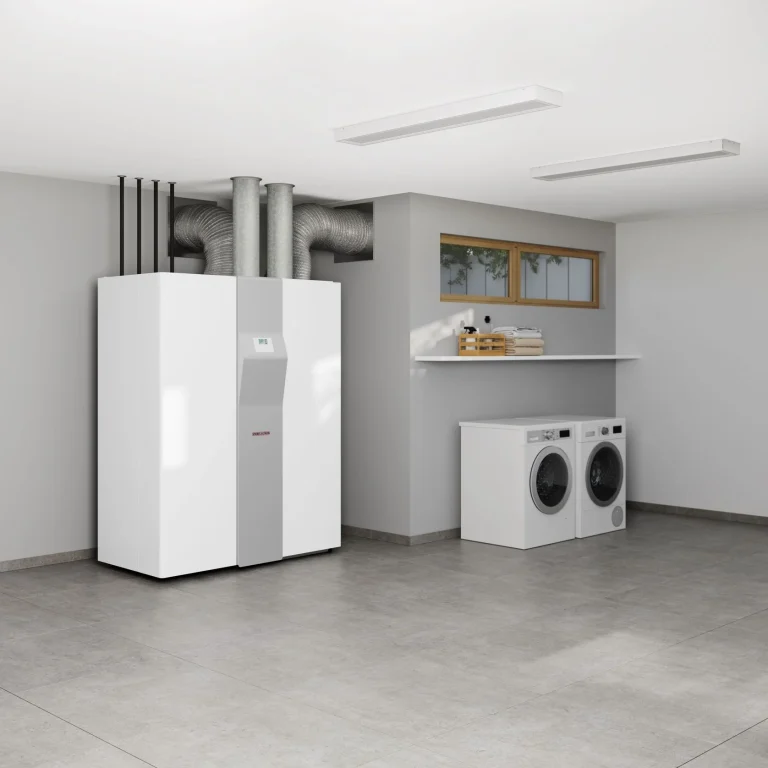
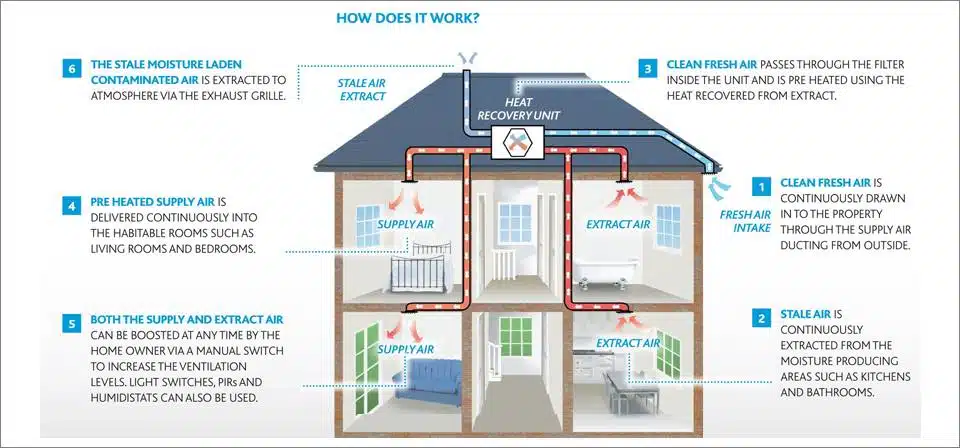
MVHR is one of those things that appears on a self-build spreadsheet as a single line and a question mark. The honest answer is that the cost depends on the house, but not so much that we cannot give you useful numbers. Here is what a system costs to buy, install and run in 2026, what pushes the price up or down, and how to think about whether it pays back.
The headline figure
For a typical three or four bedroom house, a whole-house MVHR system that has been properly designed, installed and commissioned costs between £6,000 and £7,000. That is the all-in figure: unit, ducting, terminals, design, labour and the commissioning certificate. Smaller homes and bungalows can come in below it; large houses, complex layouts and retrofits go above.
| Element | Typical cost |
|---|---|
| MVHR unit | £1,500 to £4,000 |
| Ducting, manifolds and terminals | £1,000 to £2,500 |
| Design and commissioning | £500 to £1,000 |
| Installation labour | £1,500 to £3,000 |
| Total, typical home | £6,000 to £7,000 |
- Unit: around £3,000 buys a good domestic unit with a summer bypass and humidity control.
- Ducting: semi-rigid radial systems cost more than flexible duct but are quieter and can be cleaned.
- Design and commissioning: airflow design to Part F, every valve balanced, and the certificate building control will ask for.
- Labour: first fix before plasterboard, second fix once the building is sealed. New builds sit towards the lower end of the total, retrofits above it.
What moves the price
New build or retrofit. This is the biggest single factor. In a new build the ducting goes in alongside the plumbing and electrics while the walls are open, and the unit location is planned from the start. In an existing house every duct run has to be found through ceiling voids, cupboards and boxing-in, and there is making good afterwards. Budget £7,000 to £10,000 or more for a retrofit of a finished home, and less if it is happening during a renovation when ceilings are already down.
Size and layout. More rooms means more terminals, more duct and a larger unit. A compact two-storey house with a central loft space for the unit is the cheapest layout; a sprawling bungalow with a long ridge is more work.
Unit specification. Heat recovery efficiency, a summer bypass so you are not recovering heat in July, humidity sensors that boost automatically, enthalpy exchangers, app control. Each adds cost and some are worth it; a summer bypass is one we would not skip.
Duct type. Flexible duct is cheapest and the noisiest. Semi-rigid radial ducting, with a run from a central manifold to every room, costs more but is quieter, easier to balance and can be cleaned. On a house you intend to live in for twenty years it is the better buy.

Running costs
This is where MVHR surprises people. The fans in a domestic unit draw roughly 20 to 40 watts in normal running. At the current price cap rate of 26.32p per kWh, that is around £45 to £90 a year, or a few pounds a month. Filters need changing every six to twelve months and cost £20 to £60 a set depending on the unit. There is no annual service requirement in the way there is for a heat pump, though a duct clean every few years is sensible.
Against that, the system recovers up to around 90 per cent of the heat that would otherwise leave through the ventilation. In an airtight home that heat loss would be a meaningful share of the heating bill, so the net effect of MVHR on running costs is usually positive, and that is before counting the things it prevents: condensation, mould, and the cold draughts that come with opening windows in February.
Does MVHR pay back?
On energy savings alone, slowly. MVHR is not a solar panel; its value is a comfortable, healthy, condensation-free house that meets Building Regulations without a fan in every wet room and trickle vents in every window. In a new build it is often the simplest route to Part F compliance at modern airtightness levels, and it feeds straight into the SAP calculation. Treat it as part of the fabric of the house, like the insulation, rather than an appliance that has to earn its keep in kilowatt-hours.
Is there any funding for MVHR?
Not through the Boiler Upgrade Scheme, which covers heat pumps and biomass only. In Wales, the Green Homes Wales interest-free loan covers a range of energy efficiency measures and may be worth checking for a retrofit project; we explain the scheme on our Green Homes Wales page. Self-builders can also reclaim the VAT on materials for a new dwelling, which includes the MVHR system.
Getting an accurate price
Send us your floor plans and we will design the system and give you a fixed, itemised price, usually within a few days. If the project is a renovation we will survey first. Our MVHR installation page explains the process step by step, our MVHR systems page covers the benefits in more depth, and if you are starting from scratch, MVHR explained is the place to begin. We design and install across Swansea, Carmarthenshire, Cardiff, Bridgend, Pembrokeshire and South Powys.